Bearing Flanges & Mounting Components
Components used to locate, support or mount bearing arrangements within machines and equipment.
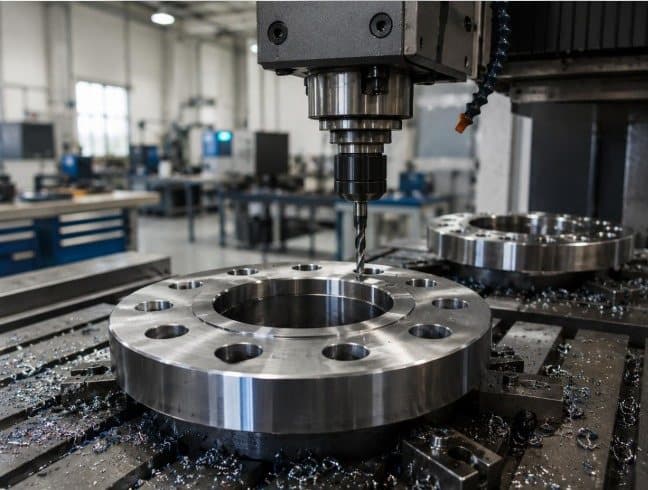
Image supplied by Navora Precision.
What is it?
What are bearing flanges & mounting components?
Bearing arrangements rarely sit loose in a machine: something has to hold the bearing in the right place, at the right height, against the right load. That is the job of bearing flanges and their related mounting components — flanged faces, locating pilots, end covers and housings that position a bearing assembly within a machine structure and react the forces it produces. The exact form is always dictated by the bearing itself and the machine around it, which is why these parts are usually specified together with the bearing designation and the assembly drawing.
How does it work?
How it works
A bearing sits between a shaft and its housing; the flange or mounting component fixes that housing to the machine and locates it precisely — a pilot or register keeps the bearing axis aligned, and the bolt pattern holds it there under load. In effect, the mounting component turns a bearing into a position in the machine.
The flange locates the bearing: bore and pilot align the axis, the bolt circle holds it in place.
Schematic only — not to scale, no specifications implied
Types & options
Common types
Rather than fixed catalogue types, these components are usually defined by the bearing and the machine. Common configurations include: Availability of any specific configuration is confirmed during engineering review.
Flanged mounting faces
Bolted interfaces that fix a bearing assembly to a structure
Locating pilots & registers
Machined features that align the bearing axis
End covers & retention
Components that retain a bearing axially in its housing
Application-specific profiles
Geometry defined by the bearing and the surrounding assembly
Reference
Typical industry ranges
Commonly manufactured values for this component family. This is public engineering knowledge — not a statement of Navora Precision capability. What applies to your part — sizes, materials, tolerances, treatments — is confirmed against your drawing during engineering review.
- Common materials
- C45 carbon steel; cast iron (e.g. FG200/GG20); aluminium alloys; stainless steel
- Bore tolerance
- Housing bores commonly H7; shaft seats k6/m6/n6 by fit class (ISO 286)
- Mounting face
- Flatness commonly held 0.02–0.05 mm on precision faces
- Bolt patterns
- Pilot diameters and PCDs matched to standard bearing series (e.g. 6200/6300) or gearbox faces
- Common finishes
- Zinc plating, painting, blackening, or left as-machined with oiled surfaces
- Lubrication provisions
- Grease nipples, oil holes, or labyrinth seals per the application
Applications
Where is it used?
Generic application contexts for this component family (public engineering knowledge).
- Machine tool spindles
- Conveyor systems
- Gearboxes and drivetrains
- Rotary indexing equipment
- Agricultural machinery
- Industrial machinery
For the engineer
Technical considerations
The engineering questions that define a good requirement for this component family. These are general considerations — your specific values are agreed during engineering review.
- Bearing interface
- The bearing designation and its mounting dimensions — bore, outside diameter, width — anchor every other dimension on the component.
- Location & alignment
- Pilot diameters, registers, flatness and perpendicularity requirements determine how accurately the bearing sits in the machine; these features are usually the critical ones.
- Load, speed & duty
- How hard the component works — forces, speeds, cycles per day — drives material, heat treatment and accuracy choices.
- Accuracy & tolerances
- Which dimensions are critical, and how tightly they must be held, determines the manufacturing route and the inspection effort.
- Mounting & interfaces
- How the part is fixed and what it mates with — shafts, housings, bolts, keys, chains — must be defined before manufacturing can be planned.
- Environment & surface treatment
- Dust, moisture, chemicals and temperature affect material choice, sealing and finishes such as plating, coating or painting.
- Lubrication & maintenance
- Whether the part runs in oil, grease or dry shapes clearances, material pairing and expected service intervals.
How to enquire
What helps us understand your requirement?
- The bearing designation it must interface with
- The drawing or assembly it mounts into
- Dimensions, or the drawing if you have one
- Material, if known
- Quantity or annual usage
- Operating conditions — load, speed, environment
- A sample or photo, if available
Don't have all of this? That's okay. Start with what you know — questions come back to you before anything is promised.
Looking for this component?
Discuss your component requirement
Share the parameters, the drawing or the sample — whatever you have. Engineering review comes before any commitment on either side.
Need something manufactured specifically for your application?
Explore Custom Manufacturing
Parts designed and manufactured around your function, envelope and interfaces — not a catalogue.