Sprockets
Toothed wheels that transfer motion through a roller chain between shafts.
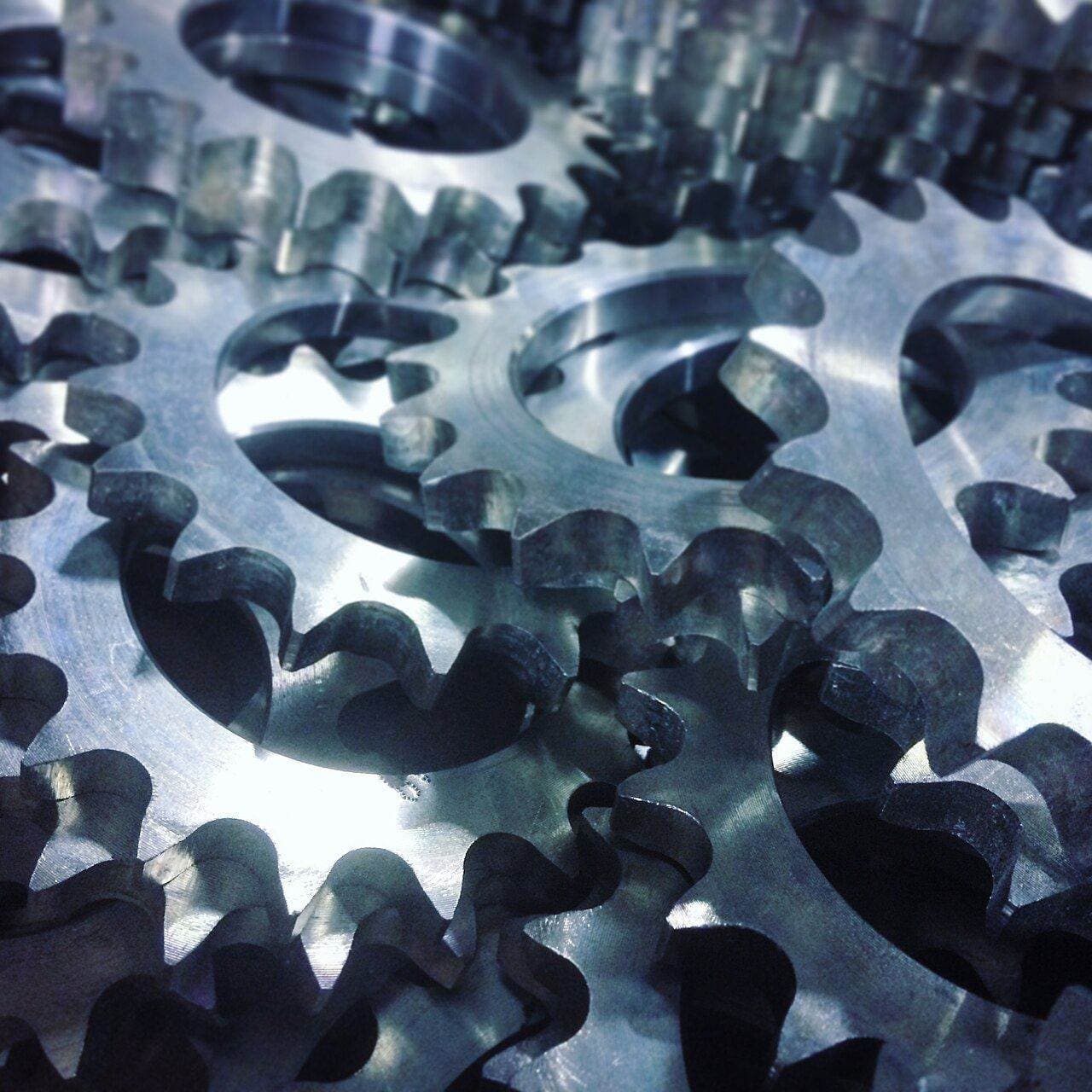
Illustrative reference image — not a Navora Precision product photo. Photo: SimonWaldherr, CC BY-SA 4.0 via Wikimedia Commons.
What is it?
What is a sprocket?
A sprocket is a wheel with shaped teeth that engage the rollers of a chain. When the drive sprocket turns, the chain carries that motion to one or more driven sprockets. Chain and sprocket drives are simple, efficient and tolerant of the rough conditions found in industrial plants — which is why they remain the default choice for conveyors, material handling equipment and agricultural machinery. Unlike friction belts, a chain positively engages the sprocket, so the drive does not slip.
How does it work?
How it works
The drive sprocket rotates and pulls the chain; the chain carries the motion around to the driven sprocket(s), which rotate in turn. The ratio between drive and driven sprocket sizes sets the speed relationship, exactly like gears but over longer distances.
Drive sprocket → chain → driven sprocket. Motion is carried between shafts that can be metres apart.
Schematic only — not to scale, no specifications implied
Types & options
Common types
Common configurations include: Availability of any specific configuration is confirmed during engineering review.
Simplex, duplex, triplex
One, two or three chain rows on a common wheel
Plate sprockets
A flat disc of teeth without a hub
Hubbed sprockets
With a central boss and bore for mounting
Conveyor or application-specific sprockets
Built around the chain and duty in question
Reference
Typical industry ranges
Commonly manufactured values for this component family. This is public engineering knowledge — not a statement of Navora Precision capability. What applies to your part — sizes, materials, tolerances, treatments — is confirmed against your drawing during engineering review.
- Chain standards covered
- ISO 606 European (04B–32B) and ANSI B29.1 (ANSI 25–240) pitch series
- Typical bore range
- ~10–120 mm in standard manufactured sprockets
- Common materials
- C45/EN8 steel most common; stainless for corrosive duty; cast iron for low speed; nylon for light duty
- Tooth hardness
- Hardened teeth ~35–45 HRC where wear life matters; unhardened acceptable for light duty
- Bore & mounting
- Plain, keyed (DIN 6885), taper-lock or QD bushed bores
- Common treatments
- Blackening, zinc plating, or painting for corrosion protection
Applications
Where is it used?
Generic application contexts for this component family (public engineering knowledge).
- Conveyors
- Material handling systems
- Agricultural machinery
- Two-wheeler and industrial drives
- Packaging lines
- Industrial machinery
For the engineer
Technical considerations
The engineering questions that define a good requirement for this component family. These are general considerations — your specific values are agreed during engineering review.
- Chain standard & size
- The chain standard and pitch (ANSI, BS/ISO and so on) come first — the sprocket must match the chain exactly, tooth for tooth.
- Tooth count & duty
- Number of teeth, strand count and the drive duty (speed, torque, environment) determine tooth form, material and hardening choices.
- Load, speed & duty
- How hard the component works — forces, speeds, cycles per day — drives material, heat treatment and accuracy choices.
- Accuracy & tolerances
- Which dimensions are critical, and how tightly they must be held, determines the manufacturing route and the inspection effort.
- Mounting & interfaces
- How the part is fixed and what it mates with — shafts, housings, bolts, keys, chains — must be defined before manufacturing can be planned.
- Environment & surface treatment
- Dust, moisture, chemicals and temperature affect material choice, sealing and finishes such as plating, coating or painting.
- Lubrication & maintenance
- Whether the part runs in oil, grease or dry shapes clearances, material pairing and expected service intervals.
How to enquire
What helps us understand your requirement?
- The type of part or component
- Dimensions, or the drawing if you have one
- Material, if known
- Quantity or annual usage
- The application it goes into
- Operating conditions — load, speed, environment
- A sample or photo, if available
Don't have all of this? That's okay. Start with what you know — questions come back to you before anything is promised.
Looking for this component?
Discuss your component requirement
Share the parameters, the drawing or the sample — whatever you have. Engineering review comes before any commitment on either side.
Need something manufactured specifically for your application?
Explore Custom Manufacturing
Parts designed and manufactured around your function, envelope and interfaces — not a catalogue.