Power Screws
Threaded elements that transmit force through screw-driven movement — in jacks, presses and clamps.
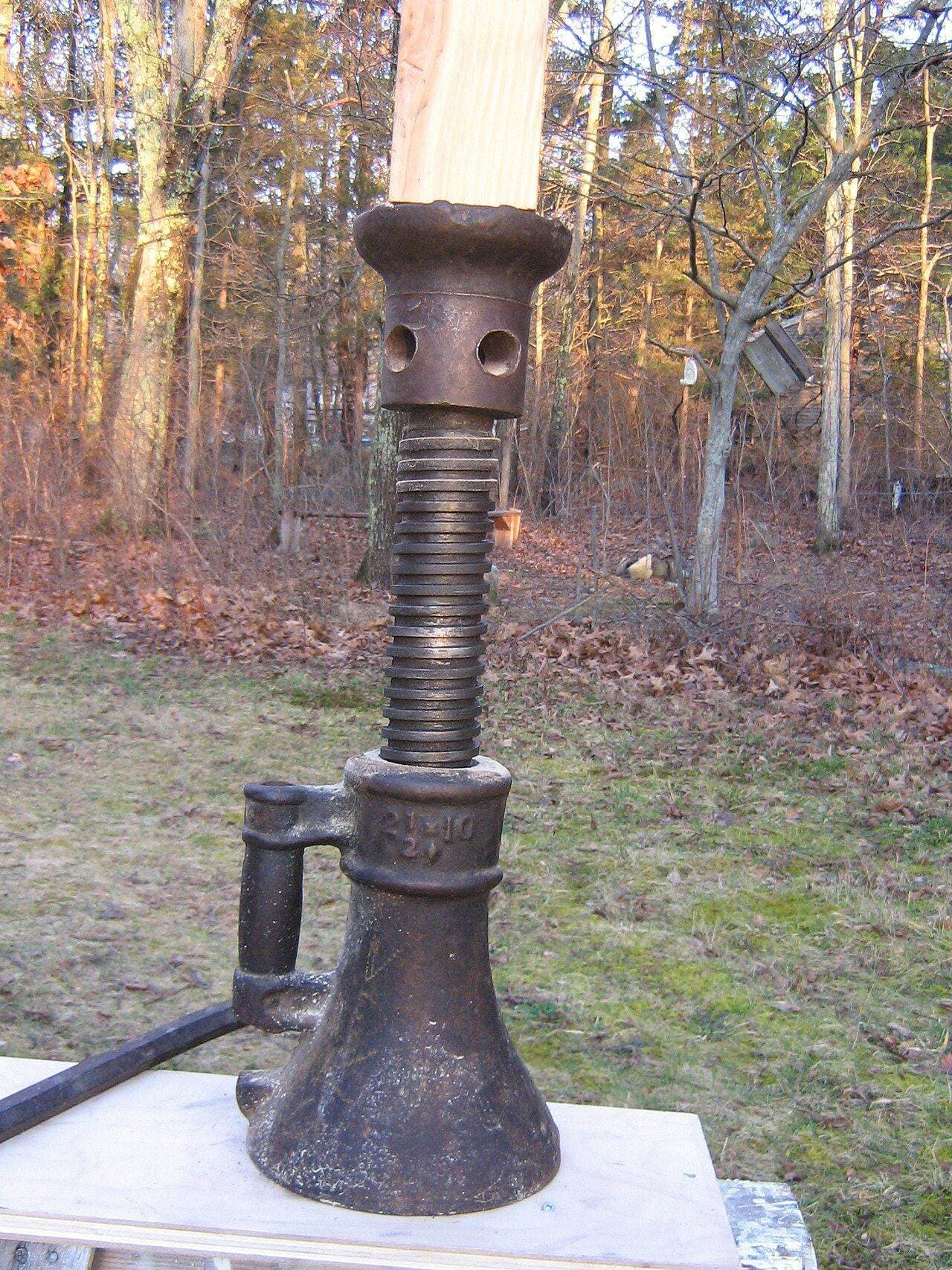
Illustrative reference image — not a Navora Precision product photo. Photo: Johnalden, CC BY-SA 3.0 via Wikimedia Commons.
What is it?
What is a power screw?
A power screw is a screw mechanism used where the job is to move or hold force, not just position. The same thread principle as a lead screw applies — rotating the screw drives a nut axially — but the proportions, thread form and materials are chosen for load: jacks, presses, vices, clamping systems and valve actuation all rely on screws to multiply input effort into large axial forces. Buyers sometimes distinguish 'power screws' (force duty) from 'lead screws' (positioning duty). The mechanism is the same; the distinction describes the application, not an absolute classification.
How does it work?
How it works
Rotational input — from a handwheel, motor or lever — turns the screw; the thread converts that rotation into axial force and movement at the nut. Because of the thread angle, the mechanism can also be self-locking: it holds the load in place when the input stops.
Rotational input → axial force and movement. The thread converts rotation into push or pull.
Schematic only — not to scale, no specifications implied
Types & options
Common types
Common force-transmission configurations include: Availability of any specific configuration is confirmed during engineering review.
Jacks and lifting screws
Vertical lift with self-locking hold
Press and clamp screws
Applying and holding squeezing force
Trapezoidal power screws
General-duty force transmission
Multi-start power screws
Where higher travel speed is needed under load
Reference
Typical industry ranges
Commonly manufactured values for this component family. This is public engineering knowledge — not a statement of Navora Precision capability. What applies to your part — sizes, materials, tolerances, treatments — is confirmed against your drawing during engineering review.
- Common diameters
- ~10–100 mm across standard jack and press screws
- Load range
- A few kN to ~100 kN across standard screw-jack sizes
- Thread forms
- Square, trapezoidal (ISO 2903), Acme, and buttress for single-direction thrust
- Self-locking rule
- Self-locking when the lead angle is below the friction angle — typically under ~5° for lubricated steel
- Common materials
- C45/EN8 carbon steel; alloy steel for high loads; bronze or cast-iron nuts
- Typical uses of multi-start
- Faster travel at the same input torque where self-locking is not needed
Applications
Where is it used?
Generic application contexts for this component family (public engineering knowledge).
- Jacks and lifting equipment
- Presses
- Vices and clamping systems
- Gate and valve actuation
- Heavy positioning systems
- Industrial machinery
For the engineer
Technical considerations
The engineering questions that define a good requirement for this component family. These are general considerations — your specific values are agreed during engineering review.
- Load & self-locking
- The axial load, duty cycle and whether the screw must hold position without input (self-locking) drive thread form, diameter, material and nut design.
- Efficiency & travel
- Thread form and lead set the balance between force multiplication and travel speed; multi-start threads favour speed, fine threads favour force.
- Load, speed & duty
- How hard the component works — forces, speeds, cycles per day — drives material, heat treatment and accuracy choices.
- Accuracy & tolerances
- Which dimensions are critical, and how tightly they must be held, determines the manufacturing route and the inspection effort.
- Mounting & interfaces
- How the part is fixed and what it mates with — shafts, housings, bolts, keys, chains — must be defined before manufacturing can be planned.
- Environment & surface treatment
- Dust, moisture, chemicals and temperature affect material choice, sealing and finishes such as plating, coating or painting.
- Lubrication & maintenance
- Whether the part runs in oil, grease or dry shapes clearances, material pairing and expected service intervals.
How to enquire
What helps us understand your requirement?
- The type of part or component
- Dimensions, or the drawing if you have one
- Material, if known
- Quantity or annual usage
- The application it goes into
- Operating conditions — load, speed, environment
- A sample or photo, if available
Don't have all of this? That's okay. Start with what you know — questions come back to you before anything is promised.
Looking for this component?
Discuss your component requirement
Share the parameters, the drawing or the sample — whatever you have. Engineering review comes before any commitment on either side.
Need something manufactured specifically for your application?
Explore Custom Manufacturing
Parts designed and manufactured around your function, envelope and interfaces — not a catalogue.