Gears
Toothed mechanical components used to transfer motion and torque between rotating shafts.
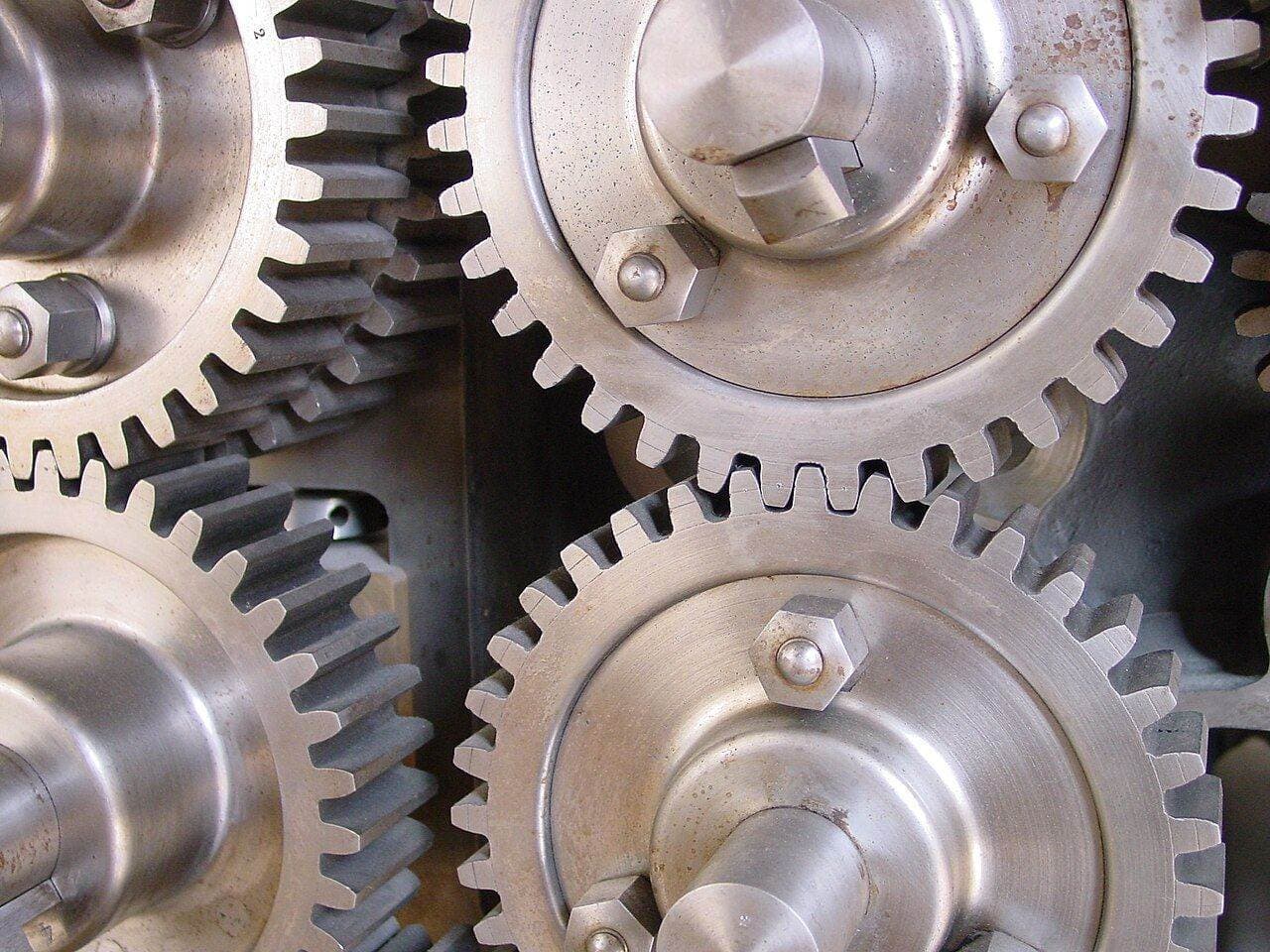
Illustrative reference image — not a Navora Precision product photo. Photo: Bachelot Pierre J-P, CC BY-SA 3.0 via Wikimedia Commons.
What is it?
What is a gear?
A gear is a rotating machine element with precisely shaped teeth around its edge. Where two gears mesh, the teeth of one push against the teeth of the other, so rotation applied to the first gear is passed to the second. Gears are one of the oldest and most common ways to transfer power between shafts, to speed something up or slow it down, and to change the direction of rotation. They appear everywhere motion must be controlled — from machine tools and gearboxes to conveyors and packaging machines.
How does it work?
How it works
When two gears mesh, the rotation of the first gear drives the rotation of the second. The relative sizes of the two gears set the relationship: a small gear driving a larger one multiplies torque and reduces speed, and the reverse multiplies speed. Intersecting or offset shafts can be driven by suitably shaped gear pairs.
Gear A drives Gear B — rotation transfers from one shaft to the other, with speed and torque changing according to the gear sizes.
Schematic only — not to scale, no specifications implied
Types & options
Common types
Common configurations include: Availability of any specific configuration is confirmed during engineering review.
Spur gears
Straight teeth; shafts are parallel
Helical gears
Angled teeth for smoother, quieter running
Bevel gears
Teeth on a cone; shafts intersect
Worm & worm wheel
High ratio between non-parallel shafts
Internal gears
Teeth cut on the inside of a ring
Reference
Typical industry ranges
Commonly manufactured values for this component family. This is public engineering knowledge — not a statement of Navora Precision capability. What applies to your part — sizes, materials, tolerances, treatments — is confirmed against your drawing during engineering review.
- Common module range
- Module 0.5–20 (coarser and finer exist)
- Typical outer diameter
- From a few mm up to ~1,000 mm in common job-shop manufacture
- Common materials
- C45/EN8 carbon steel; EN19/42CrMo4 alloy steel; EN353/20MnCr5 case-hardening steel; stainless 304/316; cast iron; brass/bronze; acetal (POM) and nylon
- Typical hardness
- Through-hardened 28–40 HRC; case-hardened 55–62 HRC surface
- Accuracy grades
- ISO 1328 / DIN 3962 grades ~5–12 (AGMA 2000 equivalents)
- Bore & keyway
- H7 bores and DIN 6885 / ISO 773 keyways are the common default
Applications
Where is it used?
Generic application contexts for this component family (public engineering knowledge).
- Machine tools
- Gearboxes and reducers
- Conveyors and material handling
- Packaging equipment
- Automation and robotics
- Industrial machinery
For the engineer
Technical considerations
The engineering questions that define a good requirement for this component family. These are general considerations — your specific values are agreed during engineering review.
- Gear geometry
- Module (tooth size), number of teeth, pressure angle, face width and helix angle define how a gear meshes with its mate and what ratio it delivers.
- Material & heat treatment
- Steel grades are usually chosen with heat treatment in mind — through-hardening for general duty, case hardening for high wear resistance. Material selection depends on load, wear, operating environment and required service life.
- Load, speed & duty
- How hard the component works — forces, speeds, cycles per day — drives material, heat treatment and accuracy choices.
- Accuracy & tolerances
- Which dimensions are critical, and how tightly they must be held, determines the manufacturing route and the inspection effort.
- Mounting & interfaces
- How the part is fixed and what it mates with — shafts, housings, bolts, keys, chains — must be defined before manufacturing can be planned.
- Environment & surface treatment
- Dust, moisture, chemicals and temperature affect material choice, sealing and finishes such as plating, coating or painting.
- Lubrication & maintenance
- Whether the part runs in oil, grease or dry shapes clearances, material pairing and expected service intervals.
How to enquire
What helps us understand your requirement?
- The type of part or component
- Dimensions, or the drawing if you have one
- Material, if known
- Quantity or annual usage
- The application it goes into
- Operating conditions — load, speed, environment
- A sample or photo, if available
Don't have all of this? That's okay. Start with what you know — questions come back to you before anything is promised.
Looking for this component?
Discuss your component requirement
Share the parameters, the drawing or the sample — whatever you have. Engineering review comes before any commitment on either side.
Need something manufactured specifically for your application?
Explore Custom Manufacturing
Parts designed and manufactured around your function, envelope and interfaces — not a catalogue.